Just started in the challenge a couple of weeks ago, yesterday I had a thought. When determining risk-reward going into a trade, the general idea seems to be to have a target gain you're shooting for, and have a risk-reward ratio in mind to get a "cut-losses" price, the price you will sell at if you're wrong and the price goes opposite of the way you're hoping, rather than waiting forever for it to bounce back and risk further losses. So if you're looking for a 15% gain, and you want a risk-reward ratio of 1-3, you cut your losses if the price goes down 5% (assuming a long position).
My thought was, if the price moves the way you want it to, as it gets closer to your target exit price, the "cut-losses" price (or downside exit price) should move with it. For example if the price gets halfway to my target and then starts to turn the other way, I'd like to give it a chance to rebound but I don't want it to go all the way down to my original downside exit price, such that I could have made half of my target gain but instead settled for a loss.
I'm sure mentally I would want to get out when there was some indication the price may not hit my target but I could still take a gain, but I wanted to be able to quantify that similar to determining risk-reward going into a trade. I came up with a simple spreadsheet to determine a new downside exit price for rising price levels above the entry price up to the target exit price.
I pasted a screenshot below. The yellow highlighted cells are the inputs: entry price, desired % gain, risk-reward ratio, and the increment you want to see from the entry price to the target exit price. This is a simple example with an entry price of 5 and target gain of 20%, $1, which yields target exit price of 6. The philosophy is that, the target exit price stays the same throughout the trade, and the initial "cut losses" price is obvious, using the 1:4 risk-reward you would cut losses at 5% ($0.25). As the price increases, the "reward" decreases as you're now closer to your target price so the potential gain is smaller. Then the same risk-reward ratio is used to determine a new risk amount based on the decreased reward amount, and that new risk subtracted from the current price gives you a new downside exit price. Obviously the closer you get to your target, the less you will risk on the downside.
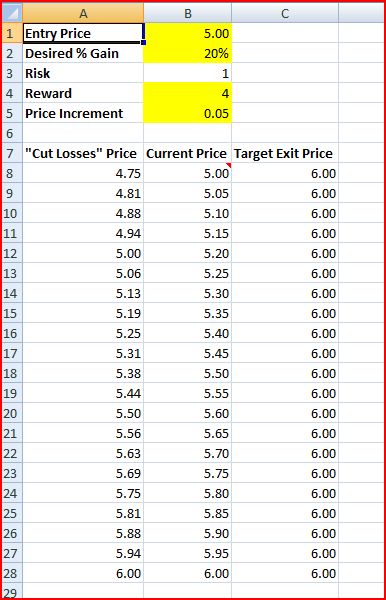
I'm guessing there are probably other ways people think about this, or maybe this is already common, I just haven't heard anything about it other than the initial risk-reward going into a trade. I tried it with a couple of paper trades this morning and I liked how it gave me a little more focus and calm when looking at the price action after entering a trade. Obviously this is just for long positions, but should be easy to make a version for shorts as well.

Join now or log in to leave a comment